Boteh-Jegheh (a.k.a Paisley), is an asymmetrical geometric floral pattern that signifies royal sovereignty, and nobility. It was the focal design in the headgears of the Iranian kings since Shah Abbas the great (1642-1666) of the Safavid Empire of Iran .
 |
Boteh Jegheh on the crown of Shah Abbas II of Iran |
Nader Shah Afshar ( 1688 – 1747) one of the most powerful Iranian kings, adorned his royal Jegheh with diamonds and emeralds after his conquest of India.
 |
Boteh_Jegheh on the Crown of Nader Shah Afshar Emperor of Iran ( 1688-1747) |
 |
| Jegheh-e-Naderi in Iran's National Jewelry Museum |
Fath-Ali Shah of Qajar (1797-1834) had a number of different Jeghehs depicted in his numerous portraits.
 |
| Fath-Ali Shah of Qajar, |
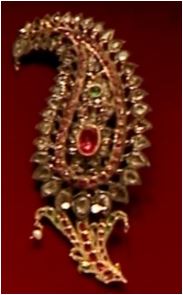 |
| Boteh -Jegheh of Crown of Fath-Ali Shah |
 |
| A Safavid period helmet. Kolah Khood |
Some authors have speculated about the origin of the Paisley pattern, theorizing, without offering any evidence, that it has originated in ancient Babylon , possibly dating back to 1700 BC. An alternative speculation, also without any evidence suggests that it is derived from a Zoroastrian symbol of fire. Some have related it to cypress tree, as a Zoroastrian symbol of eternity and life! It is argued that its floral motif originates from the Sassanid dynasty (200-650 AD)- the last Persian Empire before the rise of Islam, and its peculiar shape emanates from the impact of the Arab invasion, which is reflected in the tree being bent, symbolising the sorrow the nation!
However, one does not see this pattern in any of Zoroastrian fire temples. In contrast, the pattern is clearly visible in one of the oldest mosques called the Noh Gumbad Mosque, to the southwest of city of Balkh, in Afghanistan, built in the first half of the ninth century.
 |
| Noh Gumbad Mosque |
Noh Gumbad, refers to the nine vaults or domes that covered the original structure. These domes have since fallen, and the walls and columns of the mosque are buried in a more than a meter of mud-brick fragments.
Built of mud bricks and covered with plaster, the mosque was richly decorated on the interior with deeply carved arabesques covering the capitals, imposts, spandrels and soffits of the arcades. This stucco decoration, although weather-worn, has largely remained. The surfaces of the columns feature a crisscross pattern made of headers above a base -- largely buried -- of arabesque carvings. Floral medallions clearly depict Boteh Jegheh patterns.
 |
| Masjid-i Noh Gunbad - Interior detail showing carved paisley motifs on capital |
 |
| Masjid-i Noh Gunbad - Interior detail showing decoration on northeast face of column, capital, impost and arch soffit |
The use of Boteh Jegheh pattern have continued through time in other mosques such as the early 19th century mosque of Nasir-ol-Molk in Shiraz.
 |
| Mosaic circa early 19 century, from the mosque of Nasir-ol-Molk in Shiraz |
 |
| Dome of mosque of Nasir-ol-Molk in Shiraz |
Traditionally, Boteh Jegheh patterns was also used in the design of an Iranian high-quality hand-woven cloth called Termeh, that was used in the high officials and courtiers costumes called Khalaat.
The Iranian cities of Yazd and Kerman have the reputation of producing high-quality termeh. Yazdi and Kermani termeh were traded along the Silk Roads. Marco Polo, passed through Yazd in 1272 AD and wrote:
Termeh were also manufacturing in Kashmir in the northern India and in the Fergana valley (presently in Tajikistan and Uzbekistan). Yazdi silk designs do share some similarities with Fergana silks and Kermani shaals competed with Kashmiri shawls.
 |
| Termeh is a handicraft, which is woven with silk and wool and sometimes with gold and silver. Today it is mainly used for decorative purposes in important ceremonies |
 |
| Mohannad Shah Qajar, Emperor of Iran (1808-1848) |
 |
| Mirza Taghi Khan Farahani, Amirkabir (1807 -1852) |
 |
| A Qajar Nobleman |
 |
| Religious and political advisers of Nasser-ed-Din shah, (1848-96) Emperor of Iran, ceramic featuring paisley printed robes from Isfahan, Iran |
 |
| Boteh-Jegheh on the headgear of princes - 16th century Safavid miniature |
The Iranian cities of Yazd and Kerman have the reputation of producing high-quality termeh. Yazdi and Kermani termeh were traded along the Silk Roads. Marco Polo, passed through Yazd in 1272 AD and wrote:
Yazd also is properly in Persia; it is a good and noble city, and has a great amount of trade. They weave there quantities of a certain silk tissue known as Yazdi, which merchants carry into many quarters to dispose of.
Termeh were also manufacturing in Kashmir in the northern India and in the Fergana valley (presently in Tajikistan and Uzbekistan). Yazdi silk designs do share some similarities with Fergana silks and Kermani shaals competed with Kashmiri shawls.
 |
| A noble Qajar woman in Termeh skirt |
 |
| A Persian female gymnast performing a handstand on a knife Qajar period painting. Boteh-Jegheh design on her pantalon id noticeable. |
 |
| Boteh-Jegheh Pattern on Traditional Termeh. Termeh is a luxurious and durable cloth in which permanent natural colours are used . Today termeh is mostly used as a collectable item. Most of the Persian Termeh are elaborately embroidered using a technique, called “Sermeh Doozi”. This is an embroidery technique that was used in ancient Persia. |
 |
| Boteh-Jegheh design on Termeh-- Yazd, Iran |
 |
| A Boteh-Jegheh design on Sofreh Ghalamkar - a less expensive cotton cloth |
 |
| Another Boteh-Jegheh design on Sofreh Ghalamkar |
 |
| Sofreh Ghalamkar with Boteh-Jegheh design |
 |
| Sofreh Ghalamkar with Boteh-Jegheh design - Esfahan |
 |
| Print Stamp used for the traditional hand made shawl craft of Isfahan, Iran. |
 |
| Very fine Senneh rug with boteh-Jegheh design, with very lustrous wool. Sennehs of this size and age with a boteh design are relatively rare. |
 |
| Persian silk rug with traditional Boteh-Jegheh design |
 |
| Another Persian rug with symmetric Boteh_jegheh Design |
 |
| Boteh-Jegheh design on a Persian carpet |
In Britain Paisley is named for the shawls manufactured at the town of Paisley, Scotland. When, around the early 19th century, patterned shawls made from the soft fleece of the Kashmir goat began to be imported to Britain from India, machine-woven equivalents were made at that town to supply the growing demand that had been created for “cashmere” shawls. Paisley shawls, in silk and cotton and later in wool, with sober colouring, were beautiful in their own right.
The decline of the paisley shawl in the early 1870s happened for a number of reasons. Fashions changed, of course, and the Franco-Prussian war of 1870-1871 put a stop to exports of shawls from Kashmir, and by 1870 a woven Jacquard shawl cost as much as £1, while an identical patterned cotton shawl could be bought for a few shillings. Like any other luxury good, once the shawls were inexpensive enough that every woman could afford to own at least one, no one wanted to wear them.
 |
| An English Paisley shawl Circa 19th century |
 | ||
1808 Empress Joséphine by Baron Antoine-Jean Gros (Musée d'Art et d'Histoire at Palais Massena, Nice France) William Morris copied the pattern for his textiles and William Holman Hunt, in his Portrait of Fanny Holman Hunt employed it .
This intriguing form of design has withstood the test of time and still from time to time designers in New York, Milan and Paris use it in their catwalks.     |